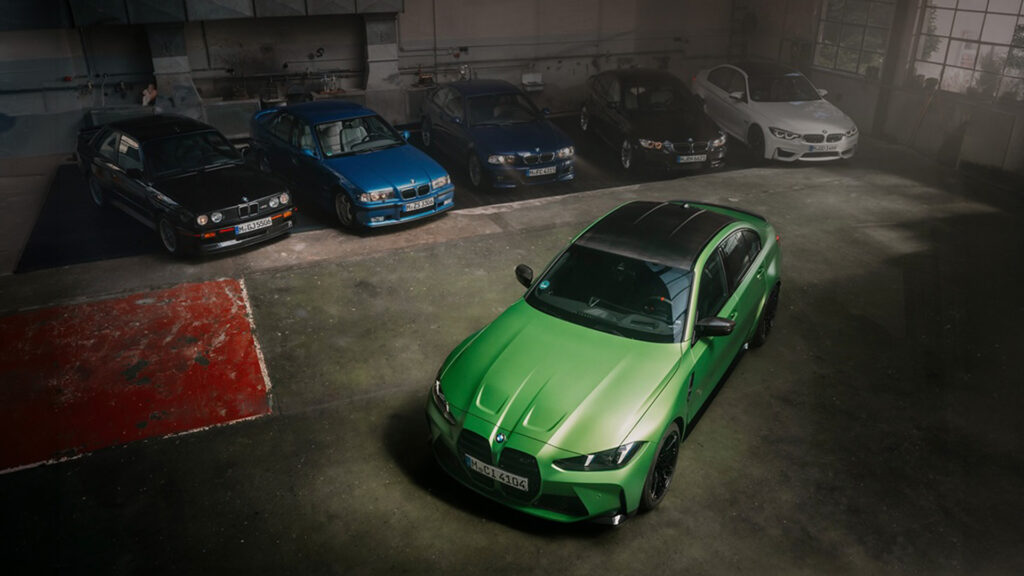


BMW M3: Four Decades of Performance, Passion and Innovation.
Since its debut in the mid-1980s, the BMW M3 has established itself as one of the automotive world’s undisputed benchmarks. Born from the demands of motorsport competition, it has evolved through the decades without ever losing sight of its core identity. Generation after generation, the M3 has bridged the gap between racing and everyday driving, delivering exceptional performance and driving pleasure both on the road and on the track.
As it celebrates its 40th anniversary, it’s time to look back at the remarkable journey of a model that, across six generations, has become an icon for six generations of drivers as well.
1986: The Birth of a Legend
The story begins with a motorsport project. In order to homologate its new touring car for competition, BMW Motorsport needed to develop and sell a road-going version directly derived from the race car. The result was the BMW M3 E30.
Unveiled at the Frankfurt Motor Show in 1985 and launched in 1986, the first M3 immediately stood out from the crowd. Under the hood was a 2.3-litre four-cylinder engine producing up to 200 horsepower. Lightweight, agile and engineered with one clear objective, performance, it quickly became a benchmark in its class.
Yet it was on the racetrack where the M3 truly built its reputation. Touring car championships, DTM races and endurance events saw the E30 rack up victories at an astonishing rate. It ultimately became the most successful touring car of its era.
Throughout its production run, several special editions were introduced, including the Evolution, Sport Evolution, and the highly sought-after Cecotto and Europameister models.
The First Convertible
BMW M also surprised enthusiasts in 1988 with the introduction of the first M3 Cabriolet. Limited to just 786 units, it remains one of the rarest and most desirable BMW M models ever produced.
1992: The M3 Comes of Age with the E36
Following the tremendous success of the E30, BMW naturally developed a second high-performance version based on the E36-generation 3 Series. Succeeding a legend is never easy, but the BMW M3 E36 rose brilliantly to the challenge and received an equally warm reception.
This second generation marked a significant turning point. The four-cylinder engine gave way to an inline-six, an engine architecture that would become deeply associated with both the M3 and BMW as a whole. At launch, it produced 286 horsepower, later increasing to 321 horsepower following a mid-cycle update.
More refined, more comfortable and more versatile, the E36 introduced the M3 and the M brand to an even broader audience. For the first time, the Bavarian performance car was available not only as a Coupé and Convertible, but also as a four-door Sedan.
This generation also introduced BMW’s VANOS variable valve timing system, improving both performance and everyday drivability.
The Rare M3 GT
In 1995, BMW M unveiled the M3 GT, a limited-edition model built in just 356 examples. More powerful, competition-focused and offered exclusively in British Racing Green, it established a tradition of radical and highly exclusive special editions.
Developed at a time when motorsport continued to shape production-car development, the M3 GT served as a reminder that the M3’s DNA remained firmly rooted in racing.
2000: The Golden Age (E46)
For many enthusiasts, the BMW M3 E46 represents the perfect balance.
With its timeless design, naturally aspirated 343-horsepower inline-six and outstanding chassis, it quickly became one of the defining sports cars of its era. More than 85,000 examples were produced, setting a record for a BMW M model at the time. By its third generation, the M3 had firmly earned its place among automotive legends.
The E46 perfectly embodied the BMW M philosophy: a high-revving engine, precise transmission and a chassis capable of delivering exceptional feedback on every drive.
The CSL Phenomenon
In 2003 came what many still consider the ultimate M3: the BMW M3 CSL, short for Coupé Sport Leichtbau (Coupé Sport Lightweight).
More than 100 kilograms lighter than the standard model, equipped with extensive carbon-fibre components and producing up to 360 horsepower, the CSL pushed the M3 concept to its absolute limit. It also introduced the exposed carbon-fibre roof, a feature that has since become a signature of BMW M’s most focused models.
More than two decades later, the M3 CSL remains a benchmark among collectors and driving enthusiasts alike. This radical special edition further reinforced BMW’s reputation as the maker of the “Ultimate Driving Machine.”
At the same time, the M3 continued its success in motorsport. The spectacular BMW M3 GTR helped BMW Motorsport secure multiple American Le Mans Series titles in the early 2000s while also competing in legendary endurance events such as the Nürburgring 24 Hours. More than just a road car, the M3 had become a global ambassador for BMW on the world’s greatest race circuits.
2007: The V8 Exception
The fourth generation of the BMW M3 fundamentally changed the formula while remaining true to the spirit of BMW M.
Available as the E90 Sedan, E92 Coupé and E93 Convertible, this generation saw BMW M make a bold decision: replacing the iconic inline-six with a naturally aspirated V8.
To this day, it remains unique in the history of the M3. Never before, and never since, has BMW’s performance icon been powered by an eight-cylinder engine. Its distinctive metallic soundtrack and willingness to rev earned it a special place among enthusiasts.
It was also during this era that BMW introduced the spectacular M3 GTS, a lightweight and uncompromising version developed for the most demanding drivers. With the GTS, BMW M openly reconnected with the spirit of homologation specials and track-focused models that had helped define the M3’s legacy from the very beginning.
2014: The F80 Revolution
The next chapter brought yet another major transformation.
As it had done with every generation before, the BMW M3 adapted to a changing automotive landscape while remaining a benchmark among premium performance cars.
BMW returned to the inline-six layout but introduced turbocharging for the first time. The results were dramatic: greater power, significantly more torque and even more impressive performance.
However, the true revolution was visible on the outside.
With this generation, the paths of the Sedan and the Coupé and Convertible models officially diverged. BMW introduced a new naming strategy: the M3 would remain exclusively a Sedan, while the Coupé and Convertible would become the BMW M4.
A new icon was born.
This decision permanently reshaped BMW’s performance lineup. For the first time, the destinies of the M3 and M4 became distinct.
Yet this separation did not mark the end of the model’s motorsport heritage. On the contrary, the BMW M4 quickly became BMW Motorsport’s flagship in DTM competition, continuing a legacy that had begun with the original M3 back in the 1980s.
The F80 era also introduced several highly desirable special editions, including the BMW M3 CS, a successful blend of performance, exclusivity and everyday usability.
2021: The Modern M3… and a Long-Awaited Dream
When the G80 generation was unveiled, it brought with it a host of technological innovations and no shortage of debate. Increased power led to the introduction of M xDrive all-wheel drive on selected models, while its bold design sparked countless discussions.
Yet once again, the performance spoke for itself.
The most important development of this era came elsewhere: the arrival of the first-ever BMW M3 Touring.
Desired by enthusiasts for more than two decades and teased by various prototypes over the years, it finally became reality in 2022 and exceeded every expectation.
Although the BMW 3 Series Touring had existed since the late 1980s, no true M3 wagon had ever reached production. For the first time, the legendary characteristics of the M3 were combined with the practicality and versatility of an estate car. Able to carry a family, luggage or sports equipment while delivering genuine M performance, it became an immediate success beyond even BMW’s expectations.
Many enthusiasts consider its arrival one of the most significant moments in modern BMW M history.
The range later expanded with the BMW M3 CS and the spectacular BMW M3 CS Touring, proving that everyday practicality and world-class performance are no longer mutually exclusive.
As a fitting symbol of this generation’s success, BMW M Motorsport eventually developed the BMW M3 Touring 24H to compete in the 2026 Nürburgring 24 Hours, just one year after a similarly extreme concept had been jokingly teased as an April Fool’s Day prank.
Forty Years of Driving Passion
For four decades, the BMW M3 has continued to evolve without ever abandoning the characteristic that made it famous in the first place: pure driving pleasure.
Generation after generation, its enduring popularity proves its ability to stand the test of time with remarkable precision.
Created to satisfy the demands of racing homologation, the BMW M3 has never truly left the world of motorsport behind. From touring car championships in the 1980s to modern endurance racing programs, every era has maintained this unique connection between competition and everyday driving.
From a limited-production homologation special to the long-awaited Touring, from CSL and CS models to DTM legends and GT-inspired specials, every generation has contributed to the enduring monument that is the BMW M3. Few cars can claim to have left such a lasting mark across so many eras.
Forty years after it first appeared, the BMW M3 remains as relevant as ever and continues to write one of the greatest stories in automotive history. With a seventh generation already on the horizon, the world’s most powerful letter has plenty more dreams to inspire.
After all, the BMW M3 still has an “Ultimate Driving Machine” reputation to uphold.