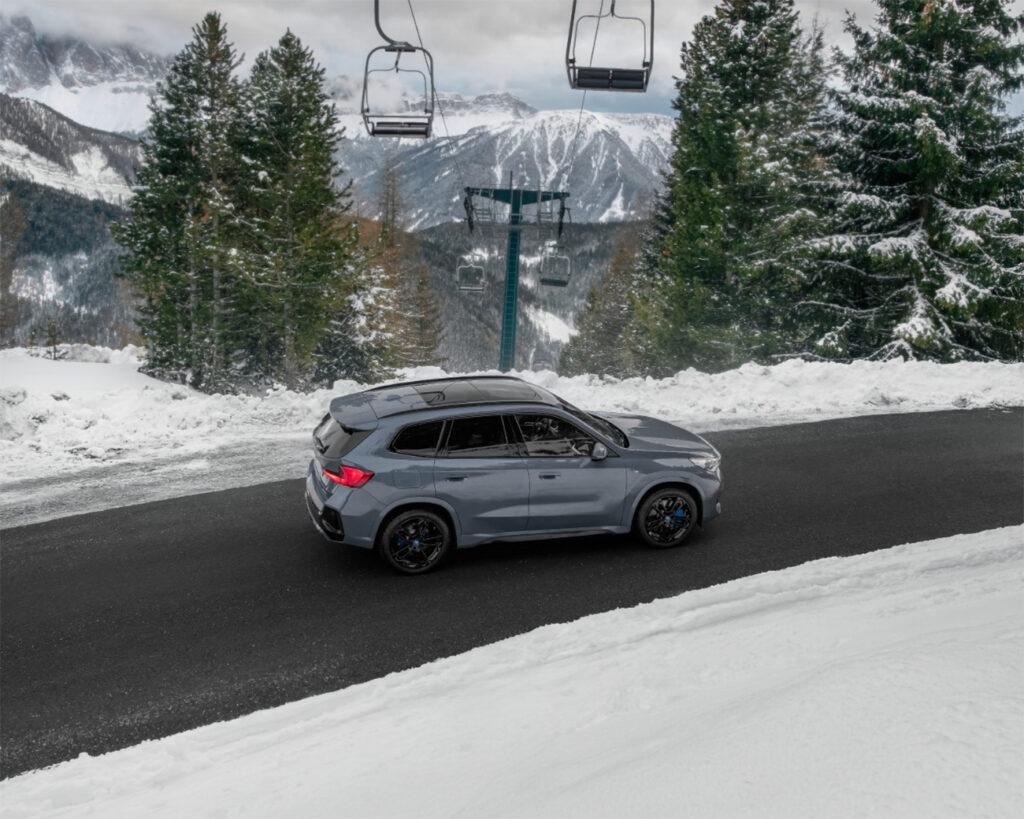


Winter Wheels in the Greater Region: What Are the Rules in Each Country?
Why Fit Winter Wheels?
Whatever the season, the total contact area between your car and the road is no larger than four hands. As road surfaces are never perfect, your safety depends on tyres that are in good condition and regularly checked. It is also essential that the vehicle, wheels and tyres are fully compatible and comply with the manufacturer’s recommendations.
Winter tyres, still too often referred to incorrectly as “snow tyres”, are not designed solely for driving in heavy snow. Their rubber compound, tread depth and structure are adapted to cold temperatures, rain and wet roads, as well as more difficult conditions such as frost, black ice and melting snow.
As temperatures fall, their design allows them to remain more flexible and provide better grip than summer tyres. Their tread pattern also helps better evacuate water and melting snow. Winter tyres are generally recommended between October and Easter, although this period varies from one year to the next. Weather and road conditions remain the true points of reference.
Depending on your vehicle and its wheels, you can choose either to replace the tyres on the original rims or to fit a complete winter wheel set. Choosing complete winter wheels helps protect the rims used in summer. Roads are generally wetter and dirtier during winter, while road salt can also be corrosive. Replacing the complete wheel also involves less handling of the tyres and rims, reducing the risk of damaging them.
Luxembourg: A Requirement Determined by the Weather
In Luxembourg, there is no official date by which winter tyres must be fitted. They become compulsory as soon as the weather and road conditions are considered wintry:
- black ice
- packed snow
- melting snow or slush
- patches of ice
- frost
The regulations apply whenever a vehicle is driven on public roads in these conditions, regardless of the time of year. In theory, a car can therefore be driven on summer tyres in the middle of winter if the road is completely clear. Conversely, suitable tyres become compulsory as soon as wintry conditions appear, even outside the usual winter season. Parked vehicles are not concerned by this requirement.
The rule also applies to vehicles registered abroad. Belgian, German and French drivers travelling through the Grand Duchy are expected to know and comply with Luxembourg regulations. Contrary to a common misconception, all four wheels must be fitted with the same type of tyre. Mixing summer and winter tyres is not permitted.
To identify compliant winter tyres, look for the following markings:
- “MS”, “M+S” or “M&S”, meaning Mud and Snow
- the 3PMSF symbol, showing a snowflake inside a three-peaked mountain and standing for Three-Peak Mountain Snowflake.
What Are the Consequences of Non-Compliance?
Driving without compliant tyres when conditions require them can result in a €74 fine and the immediate immobilisation of the vehicle.
Separately from the winter tyre requirement, using one or more tyres with a tread depth below the legal minimum of 1.6 mm is punishable by a €145 fine and the loss of two points from your driving licence.
More importantly, unsuitable equipment may complicate the assessment of liability and insurance coverage in the event of an accident. The consequences will depend on the circumstances of the incident and the conditions set out in your insurance policy. It is therefore worth checking your contract and, above all, making sure your vehicle is correctly equipped before taking to the road.
Belgium: No Obligation
Winter tyres are not compulsory in Belgium. However, they remain strongly recommended when temperatures fall or wintry conditions appear. On snowy, icy or waterlogged roads, suitable tyres can make a real difference in terms of grip, braking and vehicle control.
This difference in regulations can create a potential trap for cross-border commuters. A car may comply fully with Belgian law while fitted with summer tyres, but no longer be permitted to continue its journey just a few kilometres later after crossing into Luxembourg if the roads are affected by wintry conditions.
Snow chains are only permitted when there is a sufficient layer of snow or ice on the road, in order to avoid damaging the road surface.
France and the Grand Est Region: Requirements Limited to Certain Areas
In France, the rules are governed by the Mountain Law, known as the Loi Montagne. Between 1 November and 31 March, drivers travelling through certain municipalities located within the relevant mountain ranges must either equip their vehicles with suitable tyres or carry snow chains or snow socks.
Of the 34 French departments concerned, several are located in the Grand Est region: Meurthe-et-Moselle, Moselle, Bas-Rhin, Haut-Rhin and Vosges. However, the requirement only applies in the municipalities and areas defined by the relevant prefectural orders. Drivers should pay attention to the specific road signs indicating the entrance to an area where winter equipment is compulsory.
Unlike in Luxembourg, tyres carrying only the M+S marking are no longer sufficient. To be recognised as compliant winter tyres, they must display the alpine 3PMSF symbol, awarded following standardised snow performance tests. Drivers without four 3PMSF tyres must carry snow chains or snow socks suitable for fitting to at least two driven wheels.
For motorists who regularly travel between Luxembourg and the Grand Est, choosing four tyres with the alpine symbol is therefore the simplest solution.
If the vehicle is not fitted with four 3PMSF tyres, French regulations also allow drivers to carry snow chains or snow socks suitable for at least two driven wheels. This solution remains compatible with M+S tyres in Luxembourg, provided that the journey does not continue into Germany.
Germany: Alpine Symbol Mandatory
As in Luxembourg, Germany does not set a specific period during which winter tyres must be fitted. The requirement depends on the conditions encountered, including snow, melting snow, black ice, frost or freezing rain. As soon as road conditions become wintry, cars must be fitted with suitable tyres.
This rule also applies to vehicles registered abroad and to those simply passing through the country.
As in France, only tyres carrying the alpine symbol are recognised as winter tyres. The M+S marking alone is no longer sufficient unless it is accompanied by the 3PMSF pictogram. All-season tyres remain permitted, provided that they also carry this symbol.
What Is the Difference Between the Tyre Markings?
Two markings are commonly found on the side of winter tyres:
- M+S, meaning Mud and Snow;
- 3PMSF, represented by a snowflake inside a three-peaked mountain.
The M+S marking is based entirely on the manufacturer’s declaration and is not subject to any specific performance test. This is why France and Germany now give priority to the alpine symbol, which indicates that the tyre has passed standardised winter performance tests.
What about all-season tyres? This description does not correspond to a specific certification. All-season tyres represent a compromise and may be suitable for drivers who cover relatively few kilometres and rarely encounter difficult conditions. To be used as winter tyres in all the countries covered in this article, however, they must carry the 3PMSF symbol. The M+S marking alone remains accepted in Luxembourg, but is no longer sufficient in Germany or in the French areas covered by the Mountain Law.
Four Matching Tyres in Good Condition
For safety reasons, all four wheels should be fitted with the same type of tyre. It is also important to check that the tyres, rims and vehicle are fully compatible, including their dimensions, load ratings and speed ratings. Beyond legal compliance, this helps maintain more consistent handling between the front and rear axles during braking and changes of direction. The legal minimum tread depth is 1.6 mm in Luxembourg and Belgium. However, it is generally recommended to consider replacing winter tyres once their tread depth falls below 4 mm, helping them retain effective performance in difficult conditions.
In all cases, suitable wheels that are correctly fitted and in good condition remain essential for maintaining proper grip throughout the colder months. This is also why manufacturers develop tyres specifically adapted to the characteristics of their models. At BMW and MINI, for example, tyres carrying the star marking are designed and tested in collaboration with tyre manufacturers to meet the specific requirements of each vehicle.
Remember to check this criterion when buying a used car or a new winter wheel set. The Replay by Bilia team can advise you and help you select wheels suited to your vehicle and driving habits. Discover our selection of winter wheel sets here.